
Communicating with your children isn't always straightforward. They have endless stories, strong opinions, and a unique view of the world, firing off questions that could fill an entire afternoon. Finding the right words amid the chaos can feel daunting, especially in tense moments when frustration creeps in and responses turn into sighs or grunts.

The good news? Simple, proven phrases can smooth daily interactions, reduce arguments, and foster understanding. Drawing from years of parenting experience, child development insights, and practical wisdom passed down from my grandmother, here are 12 powerful phrases to connect more easily with your children. Try them—they work.
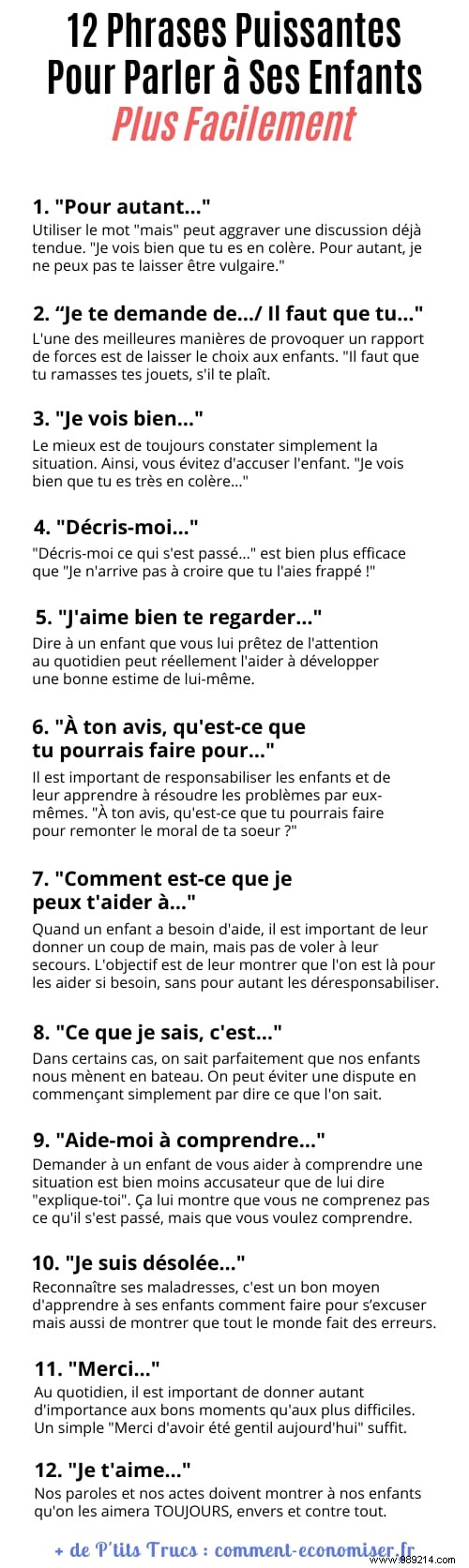
A harsh "but" can undermine positivity and escalate tension, turning "I love you but…" into something that feels conditional. Swap it for "however…" to honor both sides of the conversation.
Examples:
"I love you. However, I can't let you be vulgar."
"I'm sorry you're angry. However, I don't allow you to hit your friends."
Questions like "Are you ready to eat?" or "Can we get dressed now?" imply choice when you mean a firm request. Be direct, then add "please" for clarity and respect.
Examples:
"It's time to eat—you have to come to the table, please."
"I'm asking you to get dressed, please."
"You need to pick up your toys, please."
Start by neutrally observing: "I see you both want the same toy" or "I see you're very angry." This avoids blame, shows empathy, and invites collaboration. Describe what you observe, then let your child fill in the details.
Don't assume—let them explain first. "Describe what you drew…" beats guessing wrong (like calling a dog a bear). "Tell me what happened…" opens dialogue better than accusations, uncovering the full story.
A gem from my grandmother that I've used countless times to boost confidence. Highlight positives to encourage good behavior and build self-esteem.
Examples:
"I like watching you play with your brothers."
"I love listening to you play the piano."
"I like watching you build with Legos."
It shows attentiveness and reminds us to savor the moment.
Empower them to problem-solve instead of handing out solutions. Emphasize "you" and "your" to promote ownership.
Examples:
"What do you think you could do to cheer up your sister?"
"What do you think you could do to make up with your friend?"
"What do you think you could do to fix what you broke?"
Offer support without taking over. It reassures them you're there while encouraging independence.
Examples:
"How can I help you fix this broken toy?"
"How can I help you tidy your room?"
"How can I help you with your homework?"
When you suspect a fib or misunderstanding, state facts calmly to sidestep defensiveness.
Examples:
"What I do know is that there were 4 cookies on the plate when I left."
"What I do know is that toys can't move on their own."
"What I do know is that Laura's mom wasn't home today."
Less confrontational than "explain yourself," it signals genuine interest.
Examples:
"Help me understand how it got here."
"Help me understand what happened."
Parents mess up too. Apologizing models accountability, normalizes mistakes, and strengthens bonds through quick reconciliation.
Acknowledge efforts to reinforce positives, even on tough days. Kids thrive on recognition, just like adults.
Examples:
"Thank you for putting your snack away this morning."
"Thank you for listening so kindly."
"Thank you for helping your sister."
Or: "Thank you for tidying your room. I know you wanted to do something else first."
Say it often—before, during, and after challenges. Child development research consistently shows unconditional love as the foundation of healthy relationships and growth. It builds security, forgives imperfections, and ensures reconciliation is always possible.
